Showing posts with label Shrines. Show all posts

Sunday, May 10, 2009

Osaki Hachimangu Shrine

Osaki Hachimangu Shrine
basic information

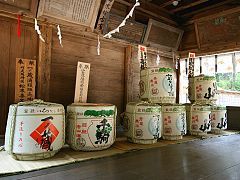
Date Masamune ordered the construction of Osaki Hachimangu in 1607 and the buildings are now a national treasure of Japan. The shrine deity, Hachimangu, is the Shinto god of war and considered to be a general guardian and protector of the city.

Osaki Hachimangu was recently restored and the shrine's renewed structure is a striking example of Date architecture and style. The main hall of the shrine is uniquely covered in black lacquer, gold leaf and brilliant colors. Some omikuji (fortunes sold by the temple for protection and good luck) are black to reflect the shrine's distinctive coloring.

Osaki Hachimangu hosts several festivals throughout the year. One of the more popular ones is Matsutaki Matsuri. This 300 year old festival celebrates the end of New Year's. The festival, common throughout Japan but particularly large at Osaki Hachimangu, involves burning decorations from New Year's celebrations and dedicating them to the shrine deities (kami).

Any advice or questions? Voice them in the forum!

how to get there

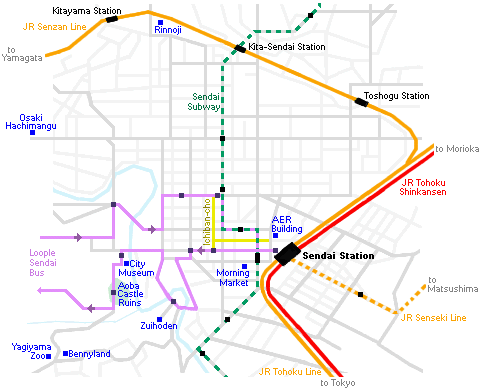
Osaki Hachimangu is about a 15 minute walk from Kunimi Station on the JR Senzan Line (15 minutes, 190 yen from Sendai Station). Alternatively, you can access the shrine by city buses from Sendai Station. However, the Loople Sendai does not serve Osaki Hachimangu.

How to get to and around Sendai

hours and fees

Hours:Shrine gift shop selling mikuji open from 9:00 to 16:00
Closed:No closing dates
Admission:Free

Friday, February 20, 2009

Dazaifu Tenmangu

Dazaifu Tenmangu
basic information

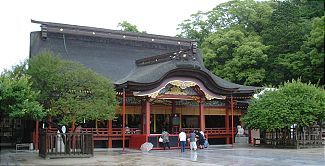
Dazaifu Tenmangu is the first and most important of several hundreds of shrines built and dedicated to the spirits of Sugawara Michizane, an influential scholar and politician of the Heian Period, who has later been identified with Tenjin, the kami ("Shinto god") of education.

After a spectacular political career, Michizane was unfairly exiled from Kyoto to Dazaifu, where he died a few years afterwards. A series of natural disasters, which followed Michizane's death, were interpreted as a consequence of exiling him unfairly, and the shrine was built on top of his grave in order to please his spirits.

There are about 6000 plum trees (ume), Michizane's favorite kind of tree, on the precincts of Dazaifu Tenmangu, including tobiume ("flying plum tree"), a tree which is said to have followed Michizane into exile by flying from Kyoto to Dazaifu. It now stands on the right side in front of the shrine's main hall.

Any advice or questions? Voice them in the forum!

how to get there

From Tenjin Station in central Fukuoka (also known as Nishitetsu Fukuoka Station), take a Nishitetsu limited express to Futsukaichi Station (12 minutes) and transfer to the Dazaifu Line to Dazaifu Station (5 minutes). Limited express trains leave Tenjin Station every 30 minutes. The one way trip costs 390 Yen.

Dazaifu Tenmangu is a 5 minute walk from Dazaifu Station.

Thursday, February 19, 2009

Kitano Tenmangu Shrine

Kitano Tenmangu Shrine
basic information

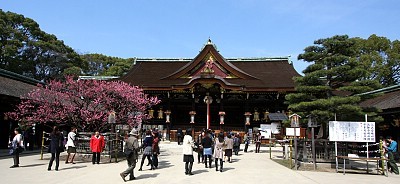
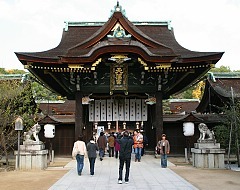
Kitano Tenmangu Shrine is one of several hundred Tenmangu Shrines across Japan. They are dedicated to Sugawara Michizane, a scholar and politician who was unfairly exiled by his political rivals. A number of disasters were attributed to his vengeful spirit after his death in exile, and these shrines were built to appease him.

Sugawara Michizane is associated with Tenjin, the kami ("Shinto god") of education, and many students come to Kitano Tenmangu to pray for success in their studies. The shrine can become especially crowded with students during exam times and school trip seasons.

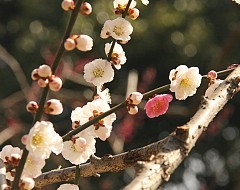
Michizane loved plum trees and one tree called tobiume, or flying plum tree, is said to have followed him from Kyoto to his exile in Kyushu. Because of this, a plum tree can always be found in front of a Tenmangu Shrine's main building.

Kitano Tenmangu has beautiful plum blossom viewing, especially in a grove of nearly 2000 trees that bloom from February to March. The shrine hosts a special tea ceremony, called Baikasai, in this plum grove every February 25th. The ceremony is performed by maiko and geiko of the nearby Kamishichiken geisha district.

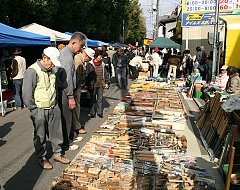
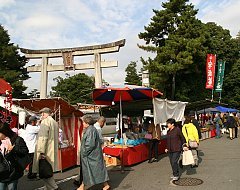
Last but not least, the shrine holds a flea market on the 25th of every month. The shrine grounds and surrounding streets are taken over by hundreds of vendors selling plants, antiques, tools, toys and crafts. There is also a large food section selling festival food such as yakisoba, karaage and takoyaki.

Any advice or questions? Voice them in the forum!

how to get there

Kitano Tenmangu Shrine can be directly reached by Kyoto City Bus number 101 from Kyoto Station (220 yen, 30 to 45 min). An indirect but perhaps quicker route is to take the Karasuma Subway Line to Imadegawa Station and catch the 102 or 203 bus to the shrine. In either case get off at the Kitano Tenmangumae bus stop.

Another alternative route would be to take bus number 205 from Kyoto Station to Kitanohakubaicho Station on the Keifuku Rail Line. It is a short walk from the station to the shrine.

Orientation in Kyoto

hours and fees

Kitano Tenmangu Shrine

Hours: Daily 5:00 to 18:00 (5:30 to 17:30 in winter)

Flea Market

Hours: 25th of every month, 6:00 to 21:00

Plum Grove

Open: February to March
Hours: 10:00 to 16:00
Admission: 600 yen

Friday, November 28, 2008

Buddhism

Buddhism
basic information

Buddhism originated in India in the 6th century BC. It consists of the teachings of the Buddha, Gautama Siddhartha. Of the main branches of Buddhism, it is the Mahayana or "Greater Vehicle" Buddhism which found its way to Japan.

Buddhism was imported to Japan via China and Korea in the form of a present from the friendly Korean kingdom of Kudara (Paikche) in the 6th century. While Buddhism was welcomed by the ruling nobles as Japan's new state religion, it did not initially spread among the common people due to its complex theories.

There were also a few initial conflicts with Shinto, Japan's native religion. The two religions were soon able to co-exist and even complement each other.

During the Nara Period, the great Buddhist monasteries in the capital Nara, such as Todaiji, gained strong political influence and were one of the reasons for the government to move the capital to Nagaoka in 784 and then to Kyoto in 794. Nevertheless, the problem of politically ambitious and militant monasteries remained a main issue for the governments over many centuries of Japanese history.
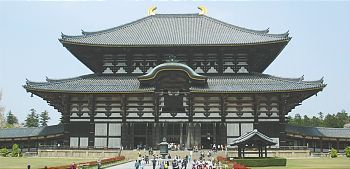
Nara's Todaiji

During the early Heian Period, two new Buddhist sects were introduced from China: the Tendai sect in 805 by Saicho and the Shingon sect in 806 by Kukai. More sects later branched off the Tendai sect. Among these, the most important ones are mentioned below:

In 1175, the Jodo sect (Pure Land sect) was founded by Honen. It found followers among all different social classes since its theories were simple and based on the principle that everybody can achieve salvation by strongly believing in the Buddha Amida. In 1224, the Jodo-Shinshu (True Pure Land sect) was founded by Honen's successor Shinran. The Jodo sects continue to have millions of followers today.

In 1191, the Zen sect was introduced from China. Its complicated theories were popular particularly among the members of the military class. According to Zen teachings, one can achieve self enlightenment through meditation and discipline. At present, Zen seems to enjoy a greater popularity overseas than within Japan.

The Lotus Hokke or Nichiren sect, was founded by Nichiren in 1253. The sect was exceptional due to its intolerant stance towards other Buddhist sects. Nichiren Buddhism still has many millions of followers today, and several "new religions" are based on Nichiren's teachings.
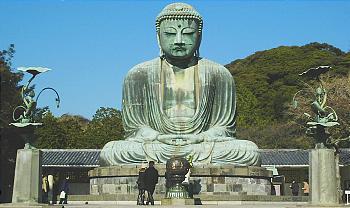
Kamakura's Great Buddha

Oda Nobunaga and Toyotomi Hideyoshi fought the militant Buddhist monasteries (especially the Jodo sects) at the end of the 16th century and practically extinguished Buddhist influence on the political sector.

Buddhist institutions were attacked again in the early years of the Meiji Period, when the new Meiji government favored Shinto as the state religion and tried to separate and emancipate it from Buddhism.

Nowadays about 90 million people consider themselves Buddhists in Japan. However, the religion does not directly affect the everyday life of the average Japanese very strongly. Funerals are usually carried out in a Buddhist way, and many households keep a small house altar in order to pay respect to their ancestors.
Tuesday, January 29, 2008

Shrines

Shinto Shrines
basic information

Shinto shrines are places of worship and the dwellings of the kami, the Shinto "gods". Sacred objects of worship that represent the kami are stored in the innermost chamber of the shrine where they cannot be seen by anybody.

People visit shrines in order to pay respect to the kami or to pray for good fortune. Shrines are also visited during special events such as New Year, setsubun, shichigosan and other festivals. New born babies are traditionally brought to a shrine a few days after birth, and many couples hold their wedding ceremonies there.

The following structures and objects can be typically found at a shrine:

Torii

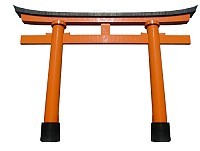
One or more torii gates mark the approach and entrance to a shrine. They come in various colors and are made of various materials. Most torii, however are made of wood, and many are painted orange and black.

Komainu

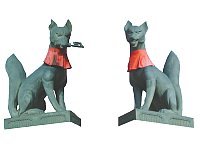
Komainu are a pair of guardian dogs or lions, often found on each side of a shrine's entrance. In the case of Inari Shrines, they are foxes (see picture) rather than dogs.

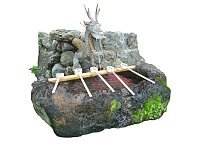
Purification through

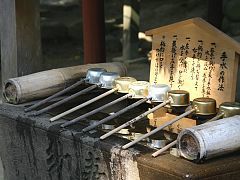
Found near the entrance, the water of these fountains is used for purification. You are supposed to clean your hands and mouth before approaching the main hall. Click here for more details.

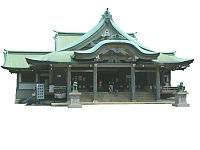
Main and offering hall

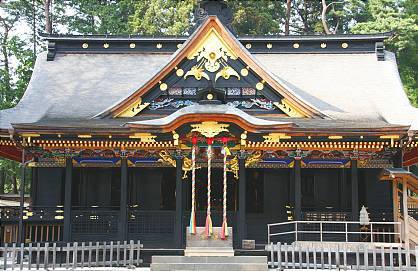
Depending on the shrine's architecture style, the main hall (honden) and offering hall (haiden) are two separate buildings or combined into one building. The main hall's innermost chamber contains the shrine's sacred object, while visitors make their prayers and offerings at the offering hall. Click here for more details.

Stage

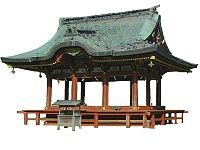
Stages for bugaku dance or no theater performances can be found at some shrines.

Ema

Shrine visitors write their wishes on these wooden plates and then leave them at the shrine in the hope that their wishes come true. Most people wish for good health, success in business, passing entrance exams, love or wealth.

Omikuji

Omikuji are fortune telling paper slips found at many shrines and temples. Randomly drawn, they contain predictions ranging from daikichi ("great good luck") to daikyo ("great bad luck"). By tying the piece of paper around a tree's branch, good fortune will come true or bad fortune can be averted.

Shimenawa

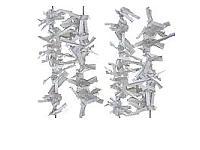
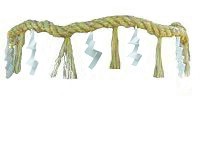
A shimenawa is a straw rope with white zigzag paper strips (gohei). It marks the boundary to something sacred and can be found on torii gates, around sacred trees and stones, etc. A rope similar to the shimenawa is also worn by yokozuna, the highest ranked sumo wrestlers, during ritual ceremonies.

There can be a variety of additional buildings such as the priest's house and office, a storehouse for mikoshi and other auxiliary buildings. Cemeteries, on the other hand, are almost never found at shrines, because death is considered a cause of impurity in Shinto, and in Japan is dealt with mostly by Buddhism.

The architecture and features of Shinto shrines and Buddhist temples have melted together over the centuries. There are several construction styles, most of which show (Buddhist) influences from the Asian mainland. Only a few of today's shrines are considered to be built in a purely Japanese style. Among them are Shinto's most important shrines, the Ise Shrines.

There are tens of thousands of shrines across Japan, some of which can be categorized into a few major groups of shrines. Some of these groups are:

  • Imperial Shrines
    These are the shrines which were directly funded and administered by the government during the era of State Shinto. They include many of Shinto's most important shrines such as the Ise Shrines, Izumo Shrine and Atsuta Shrine, and a number of shrines newly built during the Meiji Period, such as Tokyo's Meiji Shrine and Kyoto's Heian Shrine. Imperial shrines can be recognized by the imperial family's chrysanthemum crest and by the fact that they are often called "jingu" rather than "jinja".
  • Inari Shrines
    Inari Shrines are dedicated to Inari, the kami of rice. They can be recognized by fox statues, as the fox is considered the messenger of Inari. There are several ten thousand Inari Shrines across Japan, among which Kyoto's Fushimi Inari Shrine is most famous.
  • Hachiman Shrines
    Hachiman Shrines are dedicated to Hachiman, the kami of war, which used to be particularly popular among the leading military clans of the past. Of Japan's thousands of Hachiman Shrines, the most famous is probably Kamakura's Tsurugaoka Hachimangu.
  • Tenjin Shrines
    Tenjin Shrines are dedicated to the kami of Sugawara Michizane, a Heian Period scholar and politician. They are particularly popular among students preparing for entrance exams. Tenjin Shrines can be recognized by ox statues and plum trees, Michizane's favorite trees. The first and most famous Tenjin Shrine is Dazaifu Tenmangu near Fukuoka.
  • Sengen Shrines
    Sengen Shrines are dedicated to Princess Konohanasakuya, the Shinto deity of Mount Fuji. More than one thousand Sengen Shrines exist across Japan, with the head shrines standing at the foot and the summit of Mount Fuji itself.
  • Shrines dedicated to the founders of powerful clans
    Some powerful clans in Japanese history established and dedicated shrines to the their clans' founders. The most famous example are the several dozens of Toshogu Shrines dedicated to Tokugawa Ieyasu, including the famous Toshogu Shrine at Nikko. Another example is Kanazawa's Oyama Shrine which is dedicated to Maeda Toshiie, the founder of the powerful, local Maeda clan.
  • Local Shrines
    Many shrines are dedicated to local kami without association to other shrines.